Functional medicine doctors approach health differently from traditional methods. This creates numerous doubts in many minds about the legitimacy of these doctors, with questions like, are functional medicine doctors MDs?
Indeed, all functional medicine doctors are fully credentialed MDs; however, they add holistic and integrative practices to the standard medical training.
These doctors work collaboratively with their patients and develop a highly personalized treatment plan for symptoms and lifestyle.
Let’s discuss functional medicine doctors and what kind of training they go through to be able to provide this unique genre of care.
What is Functional Medicine?
Functional medicine is a system biology-based approach that always looks out for the “why” behind your health problems. It primarily focuses on identifying and addressing the root cause of the disease rather than only treating the symptoms.
It considers all the factors that impact your health wide, including diet, genetics, hormonal shifts, medications, and lifestyle, to personalize treatment plans for each patient.
Functional medicine doctors spend much more time with their patients and dig deeper to identify what might be causing health issues.
This detailed evaluation helps them come up with a very highly personalized treatment plan tailored to the patient’s needs to prevent the disease from becoming progressive. Research has shown that this approach helps to improve the patient’s health and quality of life.
These treatment plans might include medications, supplements, and various therapies, all based on the patient’s unique health profile.
How To Become a Functional Medicine Doctor?
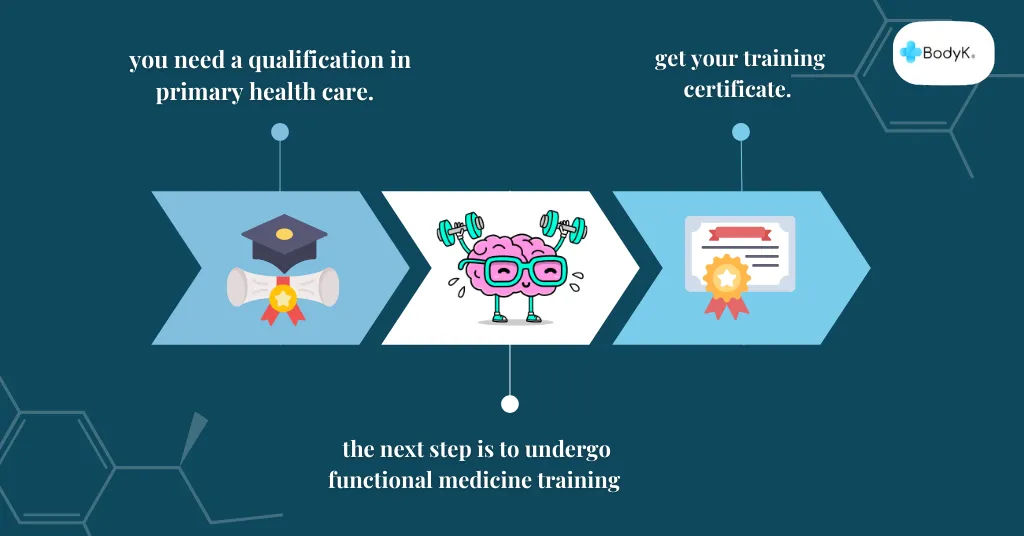
Becoming a functional medicine doctor involves specific steps, starting from foundational medical training down to specialized areas.
Here is a step-by-step guide on how you can become a functional medicine practitioner:
Eligibility
Firstly, you need a qualification in primary health care. You should be licensed in some primary specialty to be eligible for a functional medicine career. These include but are not limited to:
- Doctor of Osteopathy (DO)
- Nurse Practitioner (NP)
- Registered Dietitian (RD)
- Acupuncturist
- Pharmacist
- Doctor of Chiropractic (DC)
- Dentist
- Physician Assistant (PA)
- Registered Nurse (RN)
- Medical Doctor (MD)
- Podiatric Practitioner
Training
Once you have your degree and license, the next step is to undergo functional medicine training. This is a comprehensive training that focuses on teaching practitioners about the various aspects of a patient’s health and how to combine them to understand the underlying causes of the patient’s symptoms.
The training comprises six focus areas that include cardio, immune, applying functional medicine in clinical practice, hormone, bioenergetics, gastrointestinal, and environmental health.
Get Your Training Certificate
After completing your functional medicine training, get your training certificate. Most of the time, this certification is often provided by well-reputed accredited bodies such as the Institute for Functional Medicine (IFM).
This certificate serves as proof that you have acquired adequate knowledge and skills to practice as a functional medicine doctor.
Functional Medicine Vs. Conventional Medicine
Approach to Diseases
Conventional medicine uses a direct and simple approach to health. It focuses on symptoms for treating diseases by diagnosing them according to the body’s structure.
For instance, in the case of CAD, when a patient arrives at the hospital with chest pain and distress in breathing, the conventional doctor might order tests like an ECG to diagnose the problem and decide the next steps for treatment.
On the other hand, the functional medicine approach is both holistic and proactive. It looks deep into the systems of the body and explores the root causes, not just the symptoms.
Functional medicine doctors do not wait for symptoms to appear. Instead, they look for early signs and detection to prevent diseases like coronary artery disease (CAD).
For instance, they might use advanced tools such as BodyK screening to assess inborn errors of metabolism and signs of fatty acid oxidation in patients that can lead to CAD.
This screening performs spectral analysis of the PTG waveform to determine specific biomarkers such as PTG index (PTGi), PTGVLFi, and PTG ratio (PTGr). This allows them to calculate the PTG CVD risk score.
This PTG CVD score helps these practitioners come up with a highly personalized care plan for the prevention of cardiovascular diseases. Research showed that this spectral analysis method is noninvasive, quick, and cost-effective for assessing cardiovascular risks.
Scope of Treatment:
What Functional Medicine Can Address:
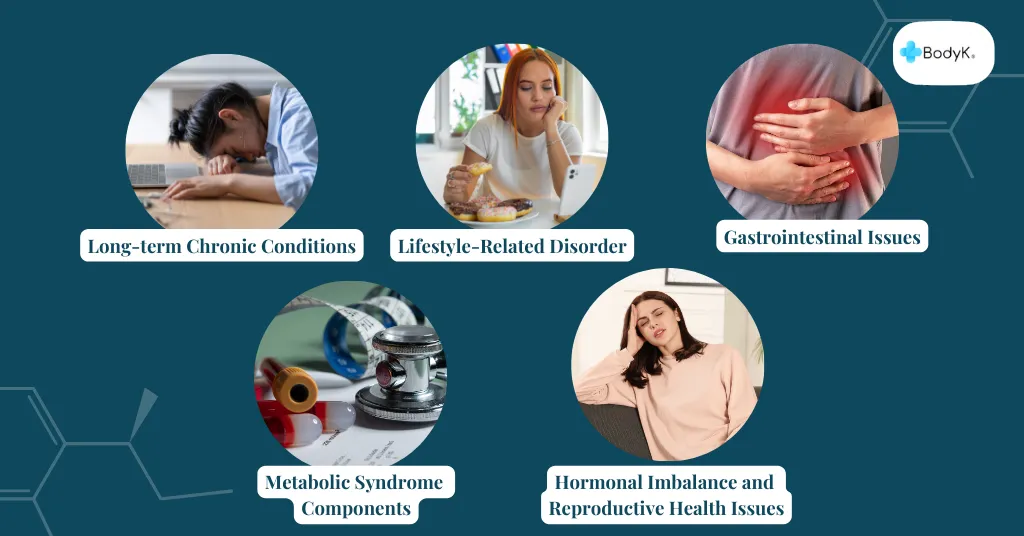
- Long-term Chronic Conditions: These include diabetes, fibromyalgia, chronic fatigue syndrome, and inflammatory disorders. For example, one study of patients with inflammatory arthritis revealed that those who were treated with the functional medicine approach had improved pain and physical health scores compared to standard care.
- Lifestyle-Related Disorders: This might include obesity and stress-induced diseases such as insomnia, memory impairment, and depression. Stress might also lead to skin diseases such as eczema.
- Metabolic Syndrome Components: For example, hypertension, insulin resistance, and dyslipidemia. Research showed that 62% of patients with hypertension were able to reduce or even discontinue their medicines while maintaining normal blood pressure with the help of a functional medicine program, including nutritional supplements and lifestyle changes.
- Gastrointestinal Issues: These include Irritable bowel syndrome as well as celiac disease.
- Hormonal Imbalance and Reproductive Health Issues: These can be polycystic ovary syndrome (PCOS), anovulation, and amenorrhea that might lead to reproductive diseases.
What Requires Conventional Medicine:
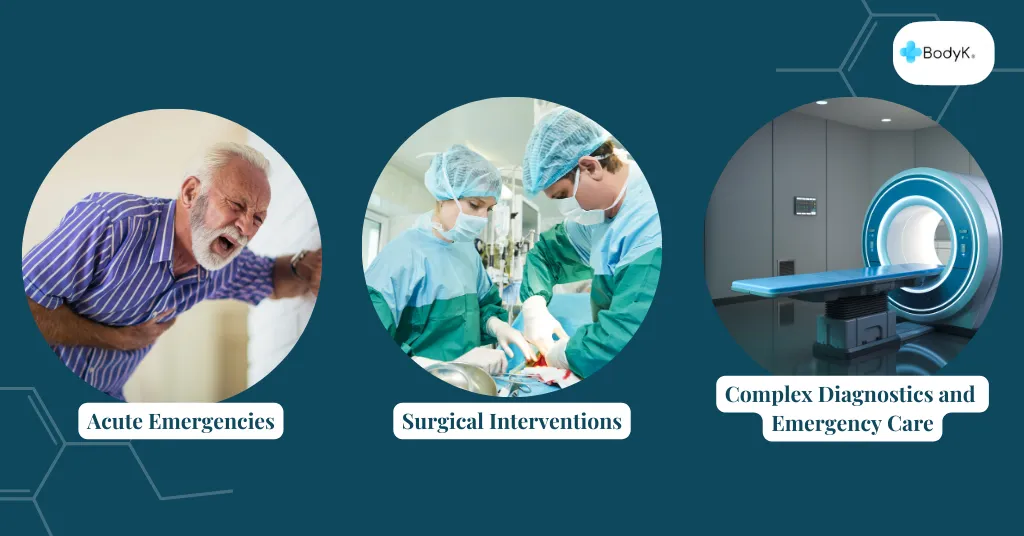
While functional medicine is often integrated into conventional treatment, there are some cases where the conventional approach tends to become necessary:
- Acute Emergencies: Such as heart attack, stroke, heart failure, or severe arrhythmias.
- Surgical Interventions: For example, appendectomies, emergency cesarean sections, or joint replacements.
- Complex Diagnostics and Emergency Care: Such as genomic sequencing, MRI, and PET scans. Or any emergency conditions, including severe asthma attacks, pneumonia, poisoning, or anaphylaxis.
Functional Medicine vs Naturopath
While both functional medicine and naturopathy belong to holistic and integrative health care, they are still very different in terms of their approach and philosophy.
| Aspects | Functional Medicine | Naturopath |
|---|---|---|
| Definition | Emphasizes patient-centered care and focuses on systems biology to search for the root cause of disease. | Emphasizes the natural healing abilities of the body and utilizes natural remedies. It is a form of alternative medicine. |
| Treatment | It integrates the traditional practices of Western medicine with alternative forms of treatment to ensure optimal health for the patient. | Prefers incorporation of herbs, supplements, and individualized dietary and lifestyle modifications to each wellness plan. |
| Diagnosis | Diagnosis heavily relies on advanced diagnostic testing and tools. | Primarily revolves around holistic assessment techniques such as dietary and lifestyle analysis and examinations of the body. |
| Education | They are usually conventionally trained as MDs or DOs but have sought additional training in functional medicine from an accredited institution. | The training of a naturopathic doctor (ND) typically involves a four-year, post-graduate, accredited program that includes clinical training. |
People Also Ask
What Is the Difference Between a Naturopath and a Functional Medicine Doctor?
Naturopaths use natural remedies and emphasize the body’s self-healing, while functional medicine doctors, usually MDs, integrate traditional Western practices with holistic approaches.
What Is the Difference Between Holistic and Functional Medicine?
Holistic medicine focuses on treating the whole person, while functional medicine delves into the root causes of diseases using a systems biology approach.
Is Integrative Medicine the Same as Naturopath?
No, integrative medicine combines conventional and alternative therapies, while naturopathy relies primarily on natural remedies and the body’s self-healing abilities.
What Is the Abbreviation for a Functional Medicine Practitioner?
Functional medicine practitioners are often abbreviated as FMP.
What Kind of Training Do Functional Medicine Doctors Undergo?
Functional medicine doctors complete traditional MD or DO training, followed by specialized functional medicine training focused on patient-centered care and root cause analysis.
Are Functional Medicine Doctors MDs?
So, are functional medicine doctors MDs? Indeed, yes, functional medicine doctors bring together traditional MD training with a holistic approach, in their practice. It is a potential game changer in healthcare, moving towards preventive and tailored care.
As it continues to grow, functional medicine may just end up redefining how most health problems are managed and treated today, focusing on wellness rather than just disease and potentially significantly bringing down healthcare costs.
References:
https://www.ncbi.nlm.nih.gov/pmc/articles/PMC6822085/
https://www.ifm.org/
https://www.ncbi.nlm.nih.gov/pmc/articles/PMC4267520/
https://www.ncbi.nlm.nih.gov/pmc/articles/PMC7544031/
https://www.ncbi.nlm.nih.gov/pmc/articles/PMC3989080/