Types of Biomarker Testing
Biomarker testing holds important value. Knowing about the types of biomarker testing has helped healthcare professionals change the way they diagnose and treat diseases.
Biomarkers are measurable signs in the body that help indicate health issues and identify diseases early. They also help monitor how well any treatment is working out for a certain person.
There are different types of biomarker testing that we will be looking at, which include PCR (Polymerase Chain Reaction), ELISA (Enzyme-Linked Immunosorbent Assay), mass spectrometry, Western blotting, next-generation sequencing (NGS), microarray analysis, and liquid biopsy.
Each method has its advantages and drawbacks that help us better understand the type of treatment that will suit us.
Different Types of Biomarker Testing
Biomarker testing includes various methods used to find biological markers in the body. The methods range from traditional ones like PCR (Polymerase Chain Technique) to newer technologies like next-generation sequencing.
If you want to key internal biomarkers efficiently, BodyK would be an excellent technology for you. In just 7 minutes, it will gather data from specific health markers and provide a detailed overview of your health status.
PCR (Polymerase Chain Reaction)

According to a paper at NCBI Bookshelf, The polymerase chain reaction (PCR) is a technique used to make many copies of specific DNA or RNA segments. The process involves repeated heating and cooling cycles which allow a special enzyme called Taq DNA polymerase to create new DNA strands.
| Advantages | Limitations |
| It is highly sensitive and allows detection of tiny amounts of DNA. | It requires precise knowledge of the target sequence. |
| It gives quick results. | Minor contamination can lead to wrong results. |
| It is used in research, diagnostic, and forensic analysis. | Not the best choice for quantitative measurements. |
ELISA (Enzyme-Linked Immunosorbent Assay)

ELISA is a popular method used to detect and measure proteins, antibodies, or hormones in blood or other samples. It works by using antibodies that stick to the specific biomarker being tested.
It is also used to track biomarkers linked to inflammation or metabolism.
| Advantages | Limitations |
| It has high specificity for detecting proteins and antibodies. | It can be time-consuming to use. |
| It is suitable for large-scale screening. | Sometimes, cross-reactivity might lead to false positives. |
| It provides quantitative results for biomarker levels. | Sensitivity depends on antibody quality. |
Mass Spectrometry

Mass spectrometry (MS) is a method used to identify and measure molecules by their weight and charge.
Mass spectrometry provides detailed information about how diseases like cancer or metabolic disorders change the body’s molecules. MS is often used in advanced medical research to detect subtle changes that other tests might miss.
| Advantages | Limitations |
| It can detect multiple biomarkers simultaneously. | It is expensive and requires specific equipment. |
| It can detect unusual biomarkers as well. | It has an intense sample preparation method |
| It provides detailed molecular information about processes. | It does not detect low-abundance molecules. |
Western Blotting

Western blotting is an important method in cell and molecular biology that is used to detect specific proteins in a mix of many proteins. This process involves three main steps:
- Separating proteins by size
- Transferring them onto a solid surface
- Special antibodies are used to highlight and visualize the target protein.
This technique helps scientists identify and study particular proteins within complex samples.
| Advantages | Limitations |
| It is highly specific for protein detection. | It is time-consuming and has multiple steps. |
| It is widely used in research and diagnostics. | It gives a relative amount of protein. |
Next-Generation Sequencing (NGS)
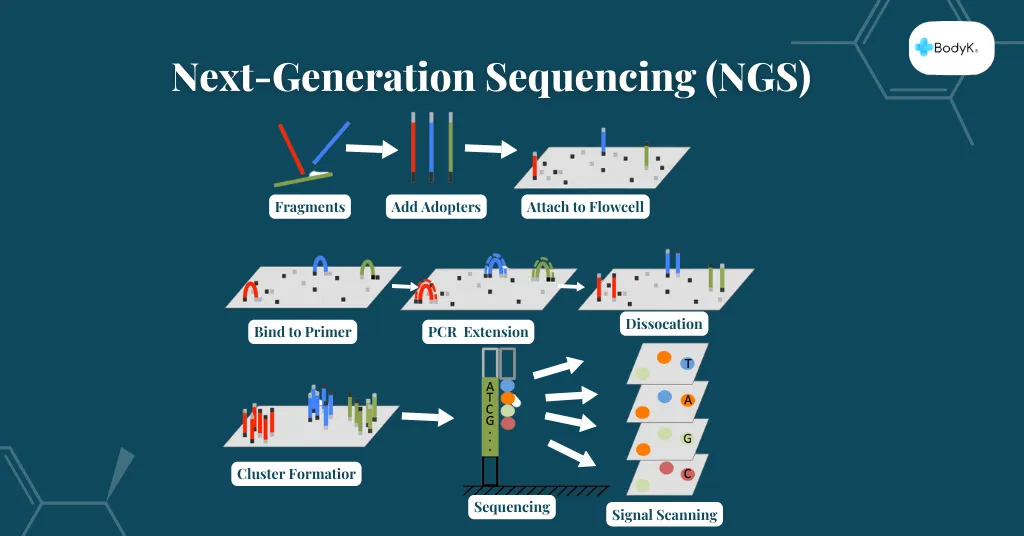
Next-generation sequencing (NGS) is a modern method for reading the DNA and RNA of genes. It can quickly sequence hundreds or even thousands of genes, or even the entire genome, in a short time.
NGS is commonly used to find gene mutations that help diagnose diseases, plan treatments, and monitor patients.
| Advantages | Limitations |
| It provides detailed data including rare mutations. | It can be expensive in the long term. |
| It is used for cancer diagnosis. | It requires excessive computational resources. |
According to Cancer Med, Microarray experiments can measure the activity of thousands of genes and create large amounts of data for analysis. In biomarker testing, it helps study gene activity and detect genetic changes.
| Advantages | Limitations |
| It is ideal for comparing samples. | It is limited to known sequences. |
| It is useful for gene expression. | It is less sensitive than NGS. |
Liquid Biopsy

Liquid biopsy is a less invasive test that looks for disease biomarkers in fluids like blood or urine. It’s often used to monitor cancer by detecting tumor DNA or cancer cells.
| Advantages | Limitations |
| It allows for repeated sampling. | It has lower sensitivity in detecting early-stage cancer. |
| It monitors tumor evolution. | It does not tell much about the tumor’s location. |
Application of Biomarker Testing

Medicine
In medicine, biomarker testing is widely used for:
- Diagnosing diseases
- Monitoring treatment effectiveness
- Tracking disease progression
For example, in cancer, specific biomarkers can indicate how a tumor is growing or responding to therapy.
Research
In research, biomarker testing is commonly used for:
- Understanding the underlying reasons for a disease
- To discover new molecules that can be affected by drugs
Environment
In the environment, different types of biomarker testing are used to:
- Track pollutants and toxins in the environment
- Helps scientists understand the impact of environmental factors on health
Technical Considerations in Biomarker Testing

Each type of biomarker testing requires different levels of sample preparation and expertise.
For example:
- PCR and ELISA require highly controlled lab environments and skilled technicians to handle samples.
- Mass spectrometry needs sophisticated instruments and precise calibration.
- For more advanced methods like next-generation sequencing (NGS), specialized equipment is necessary to analyze large datasets.
Proper sample storage and preparation are important to ensure accurate results across all types of biomarker testing.
People Also Ask
What Are the 7 Types of Biomarkers?
The seven types of biomarker testing include PCR, ELISA, mass spectrometry, Western blotting, next-generation sequencing (NGS), microarray analysis, and liquid biopsy. These methods aid in disease diagnosis and treatment monitoring.
What Is an Example of a Biomarker Test?
An example of a biomarker test is the ELISA test, which detects proteins, antibodies, or hormones in blood, aiding in diagnosing and monitoring diseases like infections or autoimmune conditions.
What Are the Methods of Biomarker Analysis?
Biomarker analysis methods include PCR, ELISA, mass spectrometry, Western blotting, next-generation sequencing (NGS), microarray analysis, and liquid biopsy. Each method offers unique insights into disease detection and monitoring.
What Are the Two Main Types of Biomarkers?
The two main types of biomarkers are diagnostic biomarkers, which help detect diseases early, and prognostic biomarkers, which monitor disease progression or treatment response in patients.
How Is Biomarker Testing Used in Medicine?
Biomarker testing in medicine diagnoses diseases, monitors treatment effectiveness, and tracks disease progression, particularly in conditions like cancer, where specific biomarkers show tumor response to therapy.
Different types of biomarker testing methods have their strengths and weaknesses. These methods help us diagnose diseases and track health changes over time. Knowledge of these biomarker testing methods can help people in the health sciences make better decisions for patient care and public safety.